Master’s thesis in progress, not yet submitted, expected 2026
Do Riot Games’ stated design intentions align with observed champion outcomes?
A champion-level evaluation of balance design across rank, role, and match phase
I map Riot’s stated balance intentions to champion-specific metrics, then compare patches 25.20 and 25.21 across rank, role and match phase. The current analysis uses 3,362 selected-champion participant observations. It describes alignment with the stated intention, without attributing the observed changes to the patch alone.
From intention to a metric
A champion’s win rate is only one outcome. I first identify what the patch says it is trying to change, then choose observable measures that match that intention, such as jungle clear output or objective damage.
I compare those measures across the two patches within rank, role and match-phase groups. The classification follows a descriptive procedure. It does not estimate a causal patch effect or establish statistical significance.
Matches collected
75,833
Matches meeting duration eligibility
71,248
Selected-champion participant observations
3,362
These counts describe different stages of the sample. Participant observations are champion appearances within matches, not an additional set of matches.
Diana: measuring jungle output
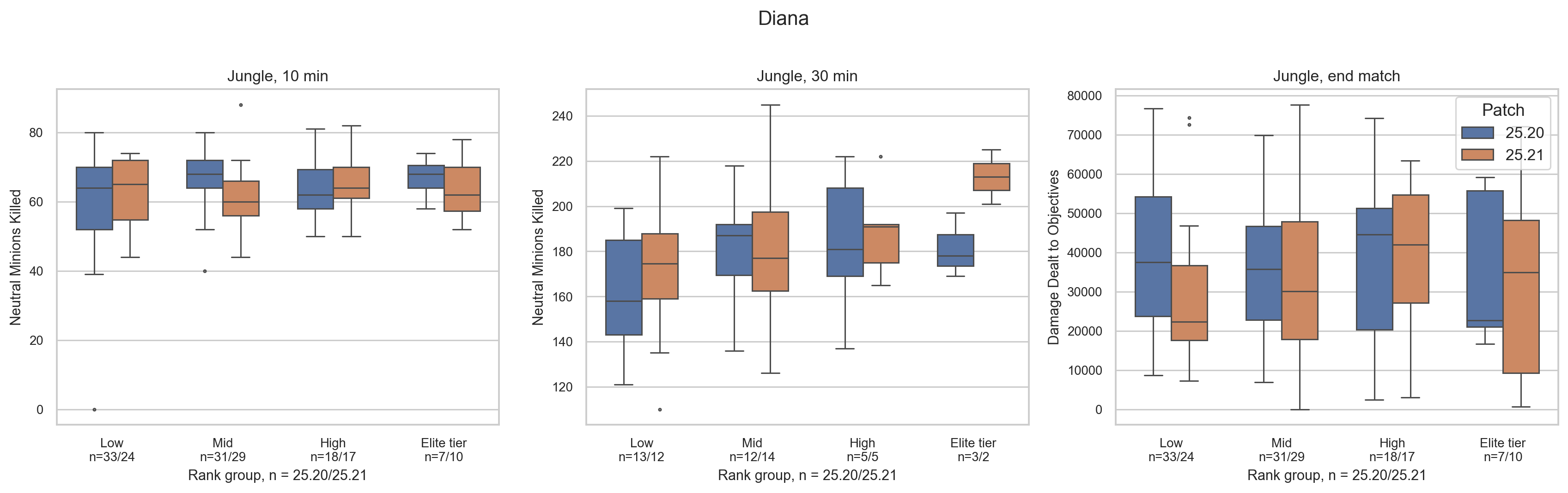
Diana’s stated intention concerned jungle efficiency in Iron through Diamond II. The current figure compares neutral minions killed at 10 and 30 minutes and end-of-match objective damage, split by rank. The neutral-minion results are mixed, while objective damage is lower. The choice of measure and checkpoint matters to the interpretation.
Existing figure from the September 4 thesis source. Sample counts differ across ranks and checkpoints. On smaller screens, scroll across the figure or open the full-size image (opens in a new tab).
Current descriptive result
Of the 12 champions classified in the current analysis, six aligned with the stated intention, one partially aligned and five did not under the thesis’s descriptive procedure. Gwen appears in sample accounting but is not classified.
Limits of the comparison
This is one patch transition with unequal sample sizes and changing role composition. Rank was recorded during collection, which may differ from rank at match time. Some checkpoints were selected after inspecting the data.
Available match and timeline fields only approximate parts of the design intention. Other changes between patches can affect the same metrics. An alignment label is therefore a description under this procedure, not a verdict on whether a balance decision worked.
The thesis is still in progress and has not been submitted. The figures and counts here come from the current analysis.