Mechanics analysis and implementation exercise

Prince of Persia (1989) Level Replica

I recreated the first Prince of Persia level in 3D to study movement, pacing, gates, buttons, falling floors, and enemy encounters.

Role
Solo Programmer and Designer
Context
  • Solo Project
  • Educational Replica
Period
2023–2024
Status
  • Released Windows build
  • source available
  • Unity 2021 LTS
  • C#
  • 3D level design
  • Gameplay scripting
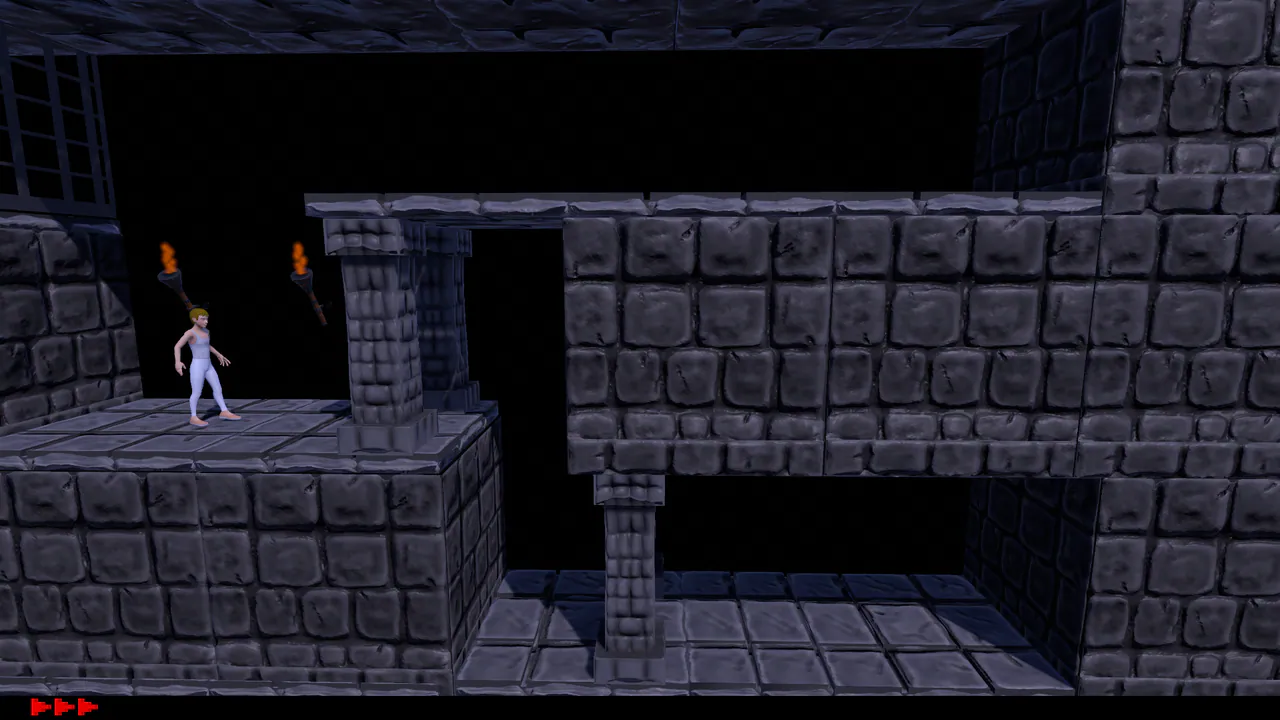
Prince of Persia (1989) educational level replica showing the side-view 3D dungeon layout
A 3D translation of the original level’s side-view pacing and traversal.

First-level replica

I replayed and researched the original first level, then rebuilt its movement, gates, buttons, falling floors and encounters in Unity/C#.

Ledge grabbing was the hardest mechanic. Recreating the original pauses and animation timing with free Unity assets required approximation.

This is a non-commercial educational project and is not affiliated with or endorsed by the owners of Prince of Persia.

Visual assets in the public build are AI-generated placeholders. The movement, level logic and gameplay code are mine.

Reconstructing ledge grabbing

  • Authored ledge triggers with hand and standing positions. Each trigger supplies the facing rotation so the controller can place and orient the player for grabbing and climbing.
  • The approach worked for this level, but was not a general ledge system. Today I would look for a more reusable detection solution.
  • Studying the original filmed/rotoscoped movement helped me work out which pauses and transitions to approximate.

Design decisions

Mechanics before embellishment
The exercise prioritised fidelity to the level’s interaction sequence and pacing instead of expanding the original design.
2D reference, 3D implementation
Camera framing and level geometry preserve the original side-view read while using a 3D environment.

What was hard

Translating a tightly timed 2D reference into 3D without losing its structure.
Broke the level into mechanic groups and used repeated comparison with the original first-level flow.

Educational context

Assessed 5 out of 5 over 162 tracked hours, in a university procedural-content-generation research context. Completed 2 April 2024 and assessed by the supervising researcher against final-year project expectations, with autonomy and problem-solving noted. The Unity prototype focused on recreating the first level’s movement, gates, pressure plates, falling floors, hazards and enemy behaviour. Recreate the intent of the original first level in 3D while preserving recognisable movement, timing, traversal, and encounter rules.
What I took from it

  • Recreating known behaviour makes small timing and camera differences easier to notice and reason about.
  • A compact reference exercise benefits from a narrow scope and clear fidelity target.